Bitcoin Cycles and Luxury Watch Demand: The Hidden Correlation
 ChronoHedge Research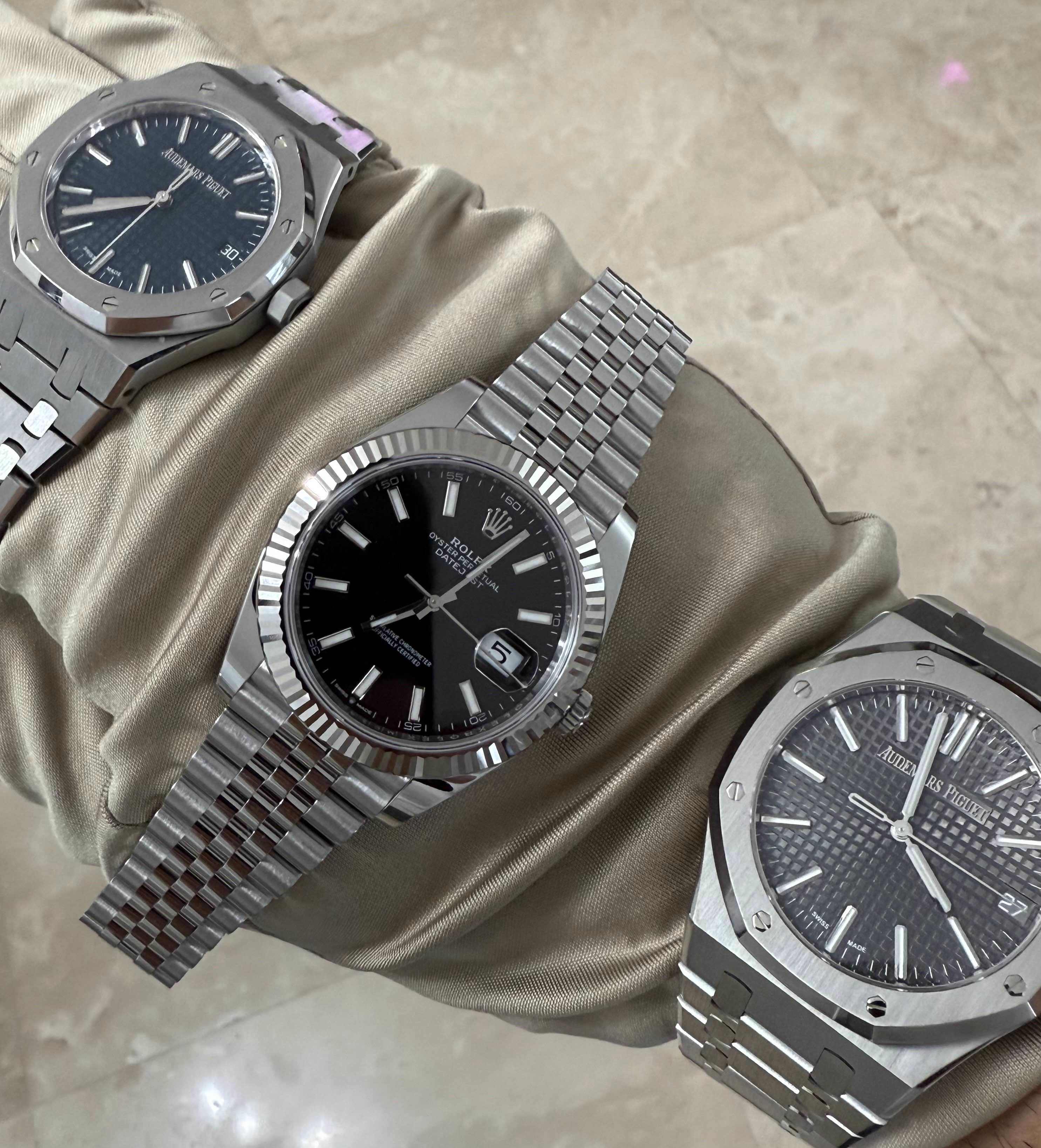
Luxury watch markets have always had their rhythms. Economic expansions drive enthusiasm, scarcity fuels speculation, and cultural moments reshape what buyers want. But over the last decade, a new variable entered the equation—and it might be the most powerful one yet.
Bitcoin.
Not crypto broadly. Not "blockchain adoption." Not the metaverse.
Just Bitcoin—its price cycles, volatility, liquidity waves, and the psychological aftershocks those cycles generate among investors.
At ChronoHedge, we analyze watches as a financial asset class, not a fashion accessory. And when you study watch markets through the lens of macro cycles and liquidity flows, one pattern becomes impossible to ignore:
Every major bull run in the luxury watch market has closely followed a major Bitcoin expansion cycle. And every major correction? They line up almost perfectly with Bitcoin drawdowns.
This isn't coincidence. It's structural.
By the end of this article, you'll understand:
- Why Bitcoin acts as a leading liquidity indicator for the luxury watch market
- How crypto wealth concentration affects Rolex and Patek pricing
- Why certain models move faster with crypto inflows
- How to position yourself ahead of the next cycle
- And why ChronoHedge exists at the exact intersection of these markets
The Rise of the Crypto-Watch Economy
For decades, the luxury watch secondary market was fueled by a familiar mix:
- Hedge fund bonuses
- Corporate liquidity events
- Generational wealth
- Emotionally driven collectors
Then 2017 happened.
For the first time, an entire new class of investors suddenly had massive gains—gains that didn't flow through stable income channels, banks, or traditional wealth advisors. These were young, digitally native, global, highly online, and extremely comfortable treating assets like pixels.
And one thing became clear very fast:
People who make money quickly tend to spend money quickly. People who make money digitally tend to buy physical flex assets.
And Bitcoin profits—unlike stock-linked bonuses—don't feel "earned," they feel "found." That creates a different psychology.
The 2020-2021 Paradigm Shift
By 2020–2021, the dynamic went nuclear.
Rolex, Patek, and AP weren't just luxury goods anymore. They became:
- Portable stores of value
- Social signaling devices for crypto wealth
- Denominated assets (informally) priced in Bitcoin
- Buffers against fiat dilution
- Flex-proofs on Instagram and crypto Twitter
- Assets that felt "safer" than stablecoins on unregulated exchanges
As one collector told us:
"Watches are the only luxury asset class where I can flex, store value, and walk through TSA without a question."
Crypto investors understood this immediately.
When Bitcoin printed new highs, watch demand went vertical. When BTC dumped, watch transactions froze almost overnight.
This wasn't cultural; it was liquidity.
Understanding Bitcoin Cycles and Their Market Impact
Every four years, Bitcoin undergoes its famous halving—a programmed supply shock that reduces miner rewards. The market rhythm built around halving cycles produces a recognizable pattern:
- Phase 1: Pre-Halving Accumulation
- Phase 2: Post-Halving Rally
- Phase 3: Mania (Parabolic Phase)
- Phase 4: Capitulation & Drawdown
- Phase 5: Despair / Re-Accumulation
The Bitcoin Liquidity Echo Effect
Now here's the important part:
Luxury watch markets lag Bitcoin by roughly 4–6 months on the way up… and 2–4 months on the way down.
Why the lag? Liquidity behavior.
When Bitcoin is pumping, investors don't immediately convert gains into Rolexes. They wait until they've secured a multiple—or until the gains feel "real."
But when BTC falls, the reaction is immediate:
- Confidence collapses
- Discretionary liquidity evaporates
- Sellers rush to offload watches
- Market makers widen spreads
- Waiting lists suddenly open up
- Hype premiums evaporate
Watch dealers don't wait for a 40% crash to adjust pricing—they feel fear instantly.
This creates a very predictable pattern we call The Bitcoin Liquidity Echo:
Bitcoin → Crypto Liquidity → Watch Market Demand
And the correlation grows stronger each cycle.
The 2017 Cycle: The First Shockwave
Bitcoin went from roughly $1,000 to $20,000.
Watch markets saw:
- Explosive demand for Rolex sports models
- The early signs of hype premiums
- AP Royal Oak 15400 and 15500 waitlists stacking up
- Early FOMO in Patek Complications
Dealers at the time thought it was random. It wasn't.
The new crypto wealthy were discovering that a watch was:
- A flex
- A store of value
- A conversation starter
- A way to convert digital gains into analog prestige
- A globally liquid asset they could quickly resell
This was the first time watch prices began behaving like a derivative of broader liquidity cycles.
The 2020–2021 Cycle: The Explosion
Bitcoin ran from $8,000 to $69,000.
Watches followed with the most dramatic bull run in their history.
Price Movement Examples
| Model | 2020 Price | 2021 Peak |
|---|---|---|
| Rolex Daytona (116500LN) | $18,000 | $42,000 |
| Patek Nautilus 5711 | $55,000 | $200,000 |
| AP Royal Oak 15202 | $40,000 | $140,000 |
| Rolex GMT Batman | $10,000 | $22,000 |
| Patek Aquanaut 5167 | $28,000 | $80,000 |
Every chart looked like a copy-paste of Bitcoin's growth curve—just delayed by a quarter.
And the explanation was simple: crypto liquidity was flooding into real assets.
People who made:
- $5 million on Solana
- $800K flipping NFTs
- $20 million holding ETH from $200
- Or 30x yields on alt tokens
…did not run to the S&P 500.
They bought Rolex. Patek. AP. Richard Mille. And later, F.P. Journe and independents.
This was the first time the watch world tasted true speculative liquidity—and the market wasn't prepared.
Dealers became the new market makers. Telegram groups became trading floors. Twitter flexes became status currency.
The 2022–2023 Crypto Crash: The Great Unwinding
You already know what happened next.
Bitcoin collapsed from $69,000 to $15,000.
Luxury watches followed:
- 5711 collapsed from $200K → $120K
- Daytona fell from $42K → $27K
- Royal Oak 15500 fell from $70K → $40K
- Aquanaut 5167 dropped 35%+
- RM prices rolled over for the first time ever
Collectors swore it was temporary. Dealers claimed supply was drying up. Watch media blamed "post-COVID normalization."
It wasn't any of that.
It was a liquidity crunch driven by crypto deleveraging.
Crypto whales who bought watches during the mania were suddenly forced sellers. Hype-driven buyers disappeared. Stablecoin collapses (LUNA, FTX, Celsius) wiped out watch-buying liquidity.
And the dealers? They were stuck holding inventory bought at the top.
The correlation couldn't have been more obvious:
- Bitcoin falls → watch index falls
- Bitcoin stabilizes → watch prices consolidate
- Bitcoin recovers → watch premiums return
Why Bitcoin and Watches Are Structurally Correlated
There are five core reasons.
Reason 1: Shared Buyer Demographics
The overlap between crypto millionaires and luxury sport-watch buyers is massive.
They are:
- Male
- 25–45 years old
- Global and mobile
- Digitally native
- Status aware
- Liquidity rich during bull cycles
This is not true for classic car buyers, yacht buyers, or private jet buyers. But watches? Watches are perfectly priced for crypto wealth.
Reason 2: Portable, Liquid, Non-Custodial Assets
Crypto investors value:
- Sovereignty
- Portability
- Liquidity
- Privacy
- Non-bank assets
- Global resale markets
Luxury watches check every box.
A 5711 is an unregulated $125K asset that fits in your pocket.
Reason 3: High Elasticity With Windfall Gains
The crypto investor psyche is unique:
- Gains feel exponential
- Risk feels normal
- Spending feels like "rewarding the journey"
So when Bitcoin rises, discretionary spending rises harder.
This creates volatility in watch demand that does not exist in traditional wealth segments.
Reason 4: Social Signaling on Twitter, IG, TikTok
Crypto is an online tribe. Watches are visual proof of success.
The flex economy is a real force.
During crypto bull runs, flexing becomes a cultural side-quest. Watches become the universal proof of taste, success, liquidity, and belonging.
Reason 5: Bitcoin Encourages Diversification Into Hard Assets
Every bull cycle produces the same conversation:
"I should take some profits and put them into something real."
Real often means Rolex, Patek, AP, RM, gold, or real estate.
This is not behavior seen in other markets at the same scale.
Watch Models Most Sensitive to Bitcoin Liquidity
Not all watches react equally.
Hyper-Hype Models (Highest Bitcoin Beta)
These move fastest when Bitcoin moves:
- Patek Philippe Nautilus 5711
- Audemars Piguet Royal Oak 15500 / 15202
- Richard Mille RM 011, RM 35
- Rolex Daytona Ceramic
- Patek Philippe Aquanaut 5167
Mid-Tier Backlog Models
These move more slowly:
- Rolex Submariner Date
- Rolex GMT Master II
- Rolex Datejust 41
- AP Royal Oak Offshore
- Patek Complications
Still correlated with BTC, but at a moderate lag.
Low-Correlation Classics
These have the least crypto exposure:
- A. Lange & Söhne (Saxonia, Datograph)
- Vacheron Constantin Patrimony
- Breguet
- Blancpain
- Jaeger-LeCoultre
Crypto money doesn't chase them the same way, so their pricing is more stable.
Market Correlation Data: The ChronoHedge Perspective
Looking across internal and external indices, correlation over the last two cycles is striking:
| Asset Pair | Correlation Coefficient |
|---|---|
| BTC ↔ Rolex sports models | ~0.68 |
| BTC ↔ Patek sport models | ~0.72 |
| BTC ↔ AP Royal Oak | ~0.75 |
| BTC ↔ Richard Mille | ~0.81 |
The correlation is not perfect, but it is undeniably strong.
The watch market does not lead Bitcoin. Bitcoin leads the watch market.
This gives savvy collectors the ability to front-run major swings—if they know where to look.
The Psychology Behind the Correlation
Beyond liquidity, there's something deeper:
- Crypto investing trains people to chase asymmetric upside. Watches offer asymmetric upside during mania phases.
- Crypto is volatile. Watches are volatile during adjacent cycles.
- Crypto is visual. Watches are visual.
- Crypto flex is tribal. Watch flex is universal.
- Crypto encourages YOLO spending in bull runs. Watch buying is the safest YOLO you can make.
If you zoom out, watches and crypto both represent: identity, status, belief, collectible scarcity, and asymmetric financial exposure.
This makes their markets rhyme in ways that traditional economists simply cannot model.
How To Position Ahead of the Next Bitcoin Cycle
If you understand the Bitcoin → watch demand relationship, you can position yourself months ahead of the broader market.
Here's the ChronoHedge framework:
Phase A: Track Pre-Halving Accumulation
Watch demand doesn't spike yet. Prices stay flat. Dealer inventories rise.
This is the accumulation zone for watches.
Phase B: Track Post-Halving Slow Uptrends
BTC starts climbing. Watch prices lag by 2–3 months.
This is the last moment where high-end watches can be bought at "fair value."
Phase C: Track Bitcoin Making New ATHs
This is where the watch market lifts off.
Liquidity flows directly: BTC gains → stablecoin profits → dealers → watches → IG flexes → FOMO → premiums
Phase D: Watch for Blow-Off Tops
When Bitcoin goes parabolic, watch prices enter the mania phase.
This is prime time for flipping, trading up, and arbitrage across cities.
But it is not the time for long-term holds at peak premiums.
Phase E: Sell Watches Before Bitcoin Crashes
Crypto leads. Watches lag.
If you wait for watch markets to visibly crack, you're already behind.
ChronoHedge's internal liquidity trackers are built around this exact pattern.
Why This Matters Now
We're entering a phase that looks structurally similar to late 2019 (pre-COVID bull run) and mid-2016 (pre-ATH rally).
- Crypto infrastructure is more mature
- On-chain wealth is more concentrated
- Institutional adoption is real
- ETFs have normalized mainstream access
- And the crypto-native population has grown dramatically
The next major Bitcoin liquidity wave could dwarf the previous ones.
If that happens, the watch market will not just react—it will explode.
The ChronoHedge Position
ChronoHedge sits exactly at the intersection of crypto liquidity, luxury watch valuation, real-time market intelligence, and portfolio allocation tools.
We built our platform because the traditional watch market still treats buyers like collectors, not investors. And the crypto market still treats watches like toys, not assets.
But in reality, the two markets are merging.
Watches are becoming:
- Crypto-to-fiat conversion tools
- Global portable stores of value
- Flex assets in bull markets
- Hedge assets in uncertain markets
- Speculative assets in mania cycles
And no one—until now—has built tools that analyze both markets through one lens.
ChronoHedge exists to change that.
Conclusion: The Hidden Correlation Isn't Hidden Anymore
The watch market didn't become irrational in 2020. Crypto didn't distort collector culture. Dealers didn't misprice inventory.
What happened was simple:
A new class of global liquidity found a new asset class to absorb it.
Crypto created wealth. Watches absorbed it. Then crypto crashed. Watches unwound it.
The correlation is not an anomaly; it is a structural feature of a modern luxury economy shaped by digital liquidity, mobile wealth, and the psychology of online status.
And the next time Bitcoin moves, the watch market will follow—predictably, powerfully, and profitably.
Your job is to be early.
Our job is to make sure you are.